Back to The Philippine Islands, 1493-1898, Volume 33, 1519-1522: Explorations by early navigators, descriptions of the islands and their peoples, their history and records of the Catholic missions, as related in contemporaneous books and manuscripts, showing the political, economic, commercial and religious conditions of those islands from their earliest relations with European nations to the close of the nineteenth century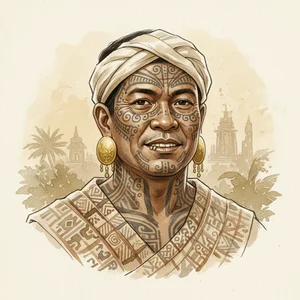 From "The Philippine Islands, 1493-1898, Volume 33, 1519-1522: Explorations by early navigators, descriptions of the islands and their peoples, their history and records of the Catholic missions, as related in contemporaneous books and manuscripts, showing the political, economic, commercial and religious conditions of those islands from their earliest relations with European nations to the close of the nineteenth century" by Pigafetta, Antonio
Raia Humabon
The king of Cebú, a native ruler who initially welcomes the Europeans but later betrays them.
Core Belief
"Humabon believes in maintaining his power and authority, even if it means betraying those who have placed their trust in him."
Worldview
Humabon views the world as a complex web of alliances and rivalries. He is constantly seeking to improve his position and protect his kingdom from external threats.
Personality
Shrewd, adaptable, and politically calculating, Humabon is initially curious and receptive to the Europeans, seeing them as potential allies. However, he is also easily swayed by others and ultimately driven by self-preservation.
In Their Own Words
"The king of Cebú is willing to accord friendship to the Europeans, but asks a tribute, as it is the custom for all visitors to pay it to him."
"With the help of the friendly king of Limasaua, peace is made according to Malay rites, and gifts exchanged."
"However, the natives are loath to destroy their idols, according to their promise, and Magalhães finds them still sacrificing to them for the cure of sickness."
Other Characters from The Philippine Islands, 1493-1898, Volume 33, 1519-1522: Explorations by early navigators, descriptions of the islands and their peoples, their history and records of the Catholic missions, as related in contemporaneous books and manuscripts, showing the political, economic, commercial and religious conditions of those islands from their earliest relations with European nations to the close of the nineteenth century
Ready to talk with Raia Humabon?
Join a discussion or make Raia Humabon your personal mentor for advice anytime.