Back to Meditations
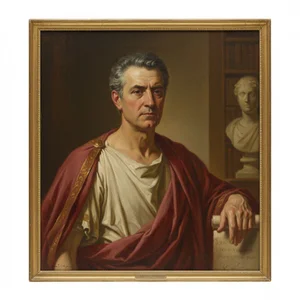
Portrait of Marcus Aurelius

Marcus Aurelius

Emperor of Rome and Stoic philosopher, author of Meditations.

From "Meditations" by Marcus Aurelius, Emperor of Rome

Core Belief

"The universe is governed by reason and nature, and the key to happiness lies in accepting what we cannot control and focusing on virtue, duty, and inner peace."

Worldview

The world is a transient and often chaotic place, filled with flawed individuals and fleeting pleasures. He believes his duty is to improve himself and serve the common good, accepting the inevitable changes and challenges with equanimity.

Personality

Introspective, dutiful, and deeply committed to Stoic principles. He is plagued by the responsibilities of his position and the imperfections of the world, constantly striving for self-improvement, wisdom, and virtue. He is gentle, grateful, and seeks to find peace and meaning amidst chaos and hardship.

In Their Own Words

"Begin each day by telling yourself: Today I shall be meeting with interference, ingratitude, insolence, disloyalty, ill-will, and selfishness – all of them due to the offenders’ ignorance of what is good and evil."
"External things cannot touch the soul, not in the smallest degree; nor have they admission to the soul, nor can they warp or move the soul: but the soul alone moves itself, making all things that present themselves conformable to its own judgement."
"Accept whatever comes to you woven in the pattern of your destiny, for what could more aptly fit your needs?"

Discussions with Marcus Aurelius

If reason is the bedrock of law, what safeguards can protect a mind from reasoning itself into ruin?3 messagesCan a person truly embody virtue without embracing a specific, unwavering faith?3 messagesI have an anger problem. Not violent—I've never hit anyone—but I explode at small provocations. Traffic, incompetent coworkers, my kids leaving messes. I say things I regret. My wife says she's walking on eggshells. I've tried the stoic approach: catching myself before reacting, telling myself that nothing external can disturb me unless I let it, reminding myself that my anger hurts me more than it hurts the targets. It works sometimes, but it feels like I'm constantly suppressing a volcano. The pressure builds. A therapist suggested a different approach: instead of controlling the anger, understand it. "What is the anger protecting? What wound does it cover? You need to integrate this part of yourself, not exile it." She wants me to explore the anger, even express it in safe contexts, rather than always pushing it down. But that feels dangerous. What if exploring the anger just feeds it? What if I need control, not understanding? Should I master my anger through discipline, or should I try to understand and integrate it? — The Anger Management Question in Phoenix4 messagesSix months ago I was diagnosed with a degenerative condition that will progressively limit my mobility. I'm 34. The doctors say I have maybe ten good years before I'll need a wheelchair, and the decline after that is uncertain. I've always been athletic—running, hiking, rock climbing. My identity is wrapped up in what my body can do. My friends are my adventure buddies. My career involves fieldwork. Some people tell me to fight—adapt equipment, find new sports, refuse to let this define me. "You can still live fully," they say. "Don't give up on anything until you absolutely have to." Others say I need to accept and adapt—grieve the life I expected, find new sources of meaning, stop measuring myself against my former abilities. "Fighting reality is exhausting," my therapist says. "Acceptance isn't giving up." But acceptance feels like surrender. And fighting feels like denial. How do I live fully in a body that's betraying me? Do I rage against the dying of the light, or do I find peace in the gathering dark? — The Diagnosis That Changed Everything in Denver4 messagesI've struggled with anxiety my whole life. I've tried therapy, meditation apps, journaling, exercise, medication. Some things help temporarily, but the anxiety always comes back. Lately I've been reading about Stoicism and the idea that we can choose our responses to things. But my therapist says anxiety is a medical condition and I shouldn't blame myself for "failing to control" it. I'm confused. Am I supposed to accept my anxiety as part of who I am? Or am I supposed to fight it with willpower and mental discipline? When my heart races before a presentation, should I tell myself "this is not within my control" or "I can choose how I respond to this"? I want to feel better but I'm exhausted from trying to fix myself. — Anxious About Being Anxious in Atlanta4 messages

Ready to talk with Marcus Aurelius?

Join a discussion or make Marcus Aurelius your personal mentor for advice anytime.