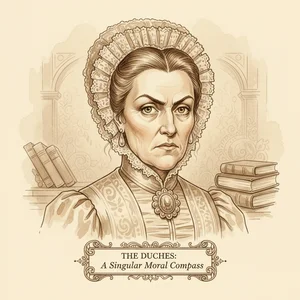
Duchess
A witty and intelligent noblewoman who enjoys playing elaborate jokes on Don Quixote and Sancho.
Core Belief
"Social hierarchies and established norms are to be upheld, but also played with for entertainment. She believes in the power of wit and intelligence to create amusement and social harmony."
Worldview
The duchess sees the world as a playground for the privileged, where social conventions can be bent and twisted for the sake of amusement. She is fascinated by the unusual and the eccentric, and enjoys using her power and influence to create elaborate scenarios for her own entertainment and that of her guests.
Personality
The duchess is intelligent, sophisticated, and somewhat mischievous. She is fascinated by Don Quixote's madness and enjoys manipulating him and Sancho for her own amusement. She is also kind and generous, providing them with hospitality and entertainment.
In Their Own Words
"“From the foregoing history of our translations of “Don Quixote,” it will be seen that there are a good many people who, provided they get the mere narrative with its full complement of facts, incidents, and adventures served up to them in a form that amuses them, care very little whether that form is the one in which Cervantes originally shaped his ideas. On the other hand, it is clear that there are many who desire to have not merely the story he tells, but the story as he tells it, so far at least as differences of idiom and circumstances permit, and who will give a preference to the conscientious translator, even though he may have acquitted himself somewhat awkwardly."
"“But after all there is no real antagonism between the two classes; there is no reason why what pleases the one should not please the other, or why a translator who makes it his aim to treat “Don Quixote” with the respect due to a great classic, should not be as acceptable even to the careless reader as the one who treats it as a famous old jest-book. It is not a question of caviare to the general, or, if it is, the fault rests with him who makes so. The method by which Cervantes won the ear of the Spanish people ought, mutatis mutandis, to be equally effective with the great majority of English readers. At any rate, even if there are readers to whom it is a matter of indifference, fidelity to the method is as much a part of the translator’s duty as fidelity to the matter. If he can please all parties, so much the better; but his first duty is to those who look to him for as faithful a representation of his author as it is in his power to give them, faithful to the letter so long as fidelity is practicable, faithful to the spirit so far as he can make it.”"
"“My purpose here is not to dogmatise on the rules of translation, but to indicate those I have followed, or at least tried to the best of my ability to follow, in the present instance. One which, it seems to me, cannot be too rigidly followed in translating “Don Quixote,” is to avoid everything that savours of affectation. The book itself is, indeed, in one sense a protest against it, and no man abhorred it more than Cervantes. For this reason, I think, any temptation to use antiquated or obsolete language should be resisted. It is after all an affectation, and one for which there is no warrant or excuse. Spanish has probably undergone less change since the seventeenth century than any language in Europe, and by far the greater and certainly the best part of “Don Quixote” differs but little in language from the colloquial Spanish of the present day. Except in the tales and Don Quixote’s speeches, the translator who uses the simplest and plainest everyday language will almost always be the one who approaches nearest to the original.”"
Discussions with Duchess
Other Characters from Don Quixote
Ready to talk with Duchess?
Join a discussion or make Duchess your personal mentor for advice anytime.