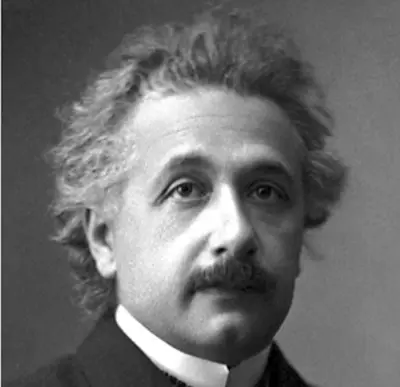
Albert Einstein
Historical Figure20th Century Germany/USA
From Einstein, the searcher : $b his work explained from dialogues with Einstein by Moszkowski, Alexander
"Imagination is more important than knowledge. Knowledge is limited. Imagination encircles the world."
About Albert Einstein
Debates featuring Albert Einstein
I feel like my brain is dying. I used to be curious about everything—I read widely, took up new hobbies, asked questions (some say constantly). Now I come home from my work, scroll my phone for three hours, then go to bed. Last week my 8-year-old asked me why the sky is blue and I said "Google it". I was so tired. Then of course I felt a huge wave of guilt, and still do whenever I think of it. Am I really this person? I want to recapture the sense of wonder I had as a kid. I want to learn things for the joy of learning, not for career advancement. But every time I try to start a new book or hobby, I give up after a few days because it feels pointless. How do I rekindle curiosity when adult life has crushed it out of me?
99 votes
Knowledge & CertaintyI'm increasingly aware of how much we don't know about climate science. Our models have significant uncertainties. New data keeps surprising us. The more I learn, the less confident I am about specific predictions. The problem is: when I express this uncertainty publicly, it gets weaponized. Deniers quote me out of context. Policy makers use my caveats as excuses for inaction. My colleagues say I'm "providing ammunition to the enemy." They want me to project confidence, even when I feel doubt. They say not to confuse people with nuance they can't handle, but I became a scientist because I believe in truth. If I overstate certainty, am I any better than the deniers who overstate doubt?
67 votes
Knowledge & DiscoveryI've discovered that a foundational assumption in my field might be wrong. My department chair says I should be very careful. He told me the current framework has been validated by decades of experiments, and my model might explain a few anomalies, but it contradicts too much established knowledge. He says I need more evidence before making claims that will make me look foolish—or worse, destroy my career before it starts. A colleague in another department says science advances through paradigm shifts, and I should publish. If I'm right, I might transform the field. If I'm wrong, well, I don't want to think about that. I believe my calculations are correct. But I also know history is full of scientists who were certain they had overturned physics and turned out to be wrong.
62 votes
Public Consultations with Albert Einstein
What advice would you give...
What do you think about...
Do you believe in quantum...
Have you ever been wrong...
What's the relationship between theory...
What is relativity, in simple...
What is relativity, in simple...
What is relativity, in simple...
What is relativity, in simple...
What's the relationship between theory...
I have a deadline to complete an oil painting, and no idea about the subject or …

What is relativity, in simple...
My partner and I can't...
Should I get a part...
Similar Mentors
Ready to consult Albert Einstein?
Get personalized advice on your real-world challenges