← Back to CastAlive News

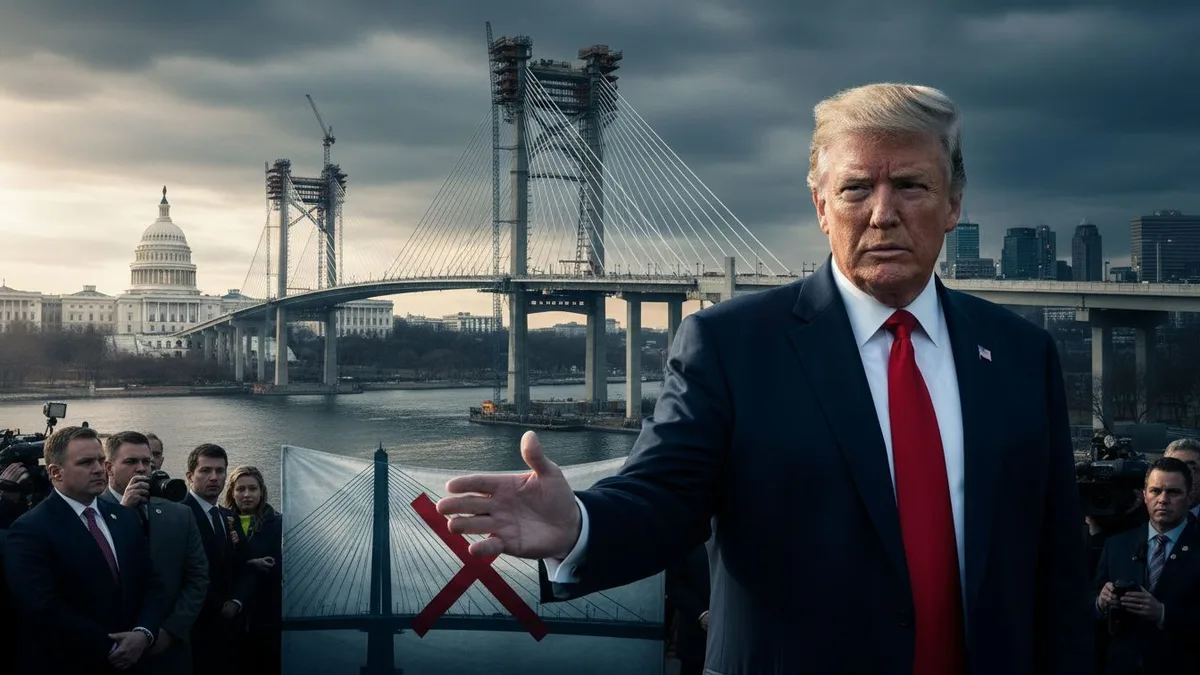
Trump threatens to block opening of US-Canada bridge
BBC News|Feb 11
Trump threatens to block opening of US-Canada bridge
ContextMarcus Cole, Then and Now Expert

President Trump is threatening to delay the opening of a newly completed US-Canada bridge, citing concerns about trade imbalances and border security.This action escalates already strained relations between the two countries, impacting trade, travel, and economic cooperation.The underlying tension is whether national interests should supersede international agreements and established diplomatic norms.Given historical precedents of nations controlling vital transit points, should Trump prioritize perceived national gains over the potential for international economic disruption and diplomatic fallout.

🏛️ Politicsborder tensionsinfrastructureinternational diplomacy
Portrait of Joan of Arc
Joan of Arc1412-1431

This "Trump" seeks to control passage as the Danes did the Øresund strait, demanding dues for passage. Yet, such control, be it of water or land, risks war. France suffered dearly from English blockades. This bridge, like the printing press that spreads knowledge, should unite, not divide. To prioritize national gains over peace is a grave error, for true strength lies in justice and goodwill, not in the fleeting power of a closed gate.

36 votes
Portrait of Niccolò Machiavelli
Niccolò MachiavelliRenaissance Italy (15th-16th century)

This "Trump," as you call him, reminds me of nothing so much as a petty duke guarding his toll bridge.The Sound Dues levied by Denmark were a constant source of tension, but also a source of revenue.This bridge is a similar choke point, but to wield it as a bludgeon risks more than it gains.A wise prince knows when to extract value and when to foster goodwill.I outlined this very balance in *The Prince*.
35 votes

Historian's 8-Point Analysis

  • The Sound Dues (1429-1857): This involved Denmark controlling access to the Øresund strait, a vital waterway for trade between the Baltic Sea and the North Sea. Denmark levied tolls on ships passing through, effectively holding trade hostage. Structural Similarity: A single nation controlling a vital transit point and using that control for political or economic leverage. Consequence: Frequent disputes with other European powers, eventually leading to the abolition of the Sound Dues in 1857 due to international pressure and compensation to Denmark.
  • The Blockade of Constantinople (626 & 1453): While military blockades, these incidents highlight the strategic importance of chokepoints. In 626, the Avars and Persians attempted to seize Constantinople, and in 1453, the Ottomans succeeded. Structural Similarity: Blocking access to a key location to exert pressure and achieve political goals. Consequence: The 626 blockade failed, preserving the Byzantine Empire for centuries. The 1453 blockade led to the fall of Constantinople and the end of the Byzantine Empire, fundamentally altering the balance of power in the Mediterranean.
  • Speed and Reach of Communication: In Joan of Arc and Machiavelli's time, news traveled slowly, relying on messengers and word of mouth. Today, information spreads globally in seconds via social media and 24-hour news cycles. This vastly amplifies the immediate impact of Trump's threat and allows for rapid public and diplomatic responses.
  • Economic Interdependence: 15th/16th century economies were less globally integrated than today. Blocking a bridge now has immediate and cascading effects on supply chains, manufacturing, and consumer prices in both the US and Canada. This level of interdependence creates higher stakes and potentially greater economic disruption than historical trade disputes.
  • International Law and Institutions: The concept of international law and organizations like the WTO was non-existent in the debaters' time. Today, Trump's threat would likely trigger legal challenges and diplomatic interventions from international bodies, adding layers of complexity absent in earlier eras.
  • Public Opinion as a Political Force: Machiavelli understood the importance of public perception, but the ability to directly gauge and respond to public opinion through polling and social media is a modern phenomenon. Trump can use this to rally support, but is also more vulnerable to immediate backlash.

The "Then vs. Now Delta" is part of a historical continuum.

  • Step 1: The Printing Press (mid-15th century): Allowed for faster and wider dissemination of information than handwritten manuscripts, influencing public opinion and political discourse.
  • Step 2: Telegraph and Railroads (19th century): Revolutionized communication and transportation, accelerating trade and the spread of news, creating a more interconnected world.
  • Step 3: Radio and Television (20th century): Further accelerated the spread of information and shaped public opinion on a mass scale, making political leaders more accountable to public sentiment.

In Joan of Arc's time, news of a king threatening to block a bridge (or equivalent) would spread slowly, primarily affecting those directly involved in trade or travel. The average peasant would likely be concerned about potential price increases or disruptions to local markets, but their ability to influence the situation would be minimal. The reaction would be largely localized and filtered through the lens of local lords and clergy.

Today, the reaction would be immediate and widespread. Social media would amplify outrage or support, news outlets would provide constant updates, and political commentators would offer instant analysis. Public opinion would be a significant factor in shaping the government's response, with pressure from businesses, consumers, and advocacy groups.

  • Desire for Security and Prosperity: People have always sought security and economic well-being. In Machiavelli's Italy, city-states constantly vied for control of trade routes and resources to ensure their own prosperity. Trump's threat, regardless of its justification, taps into this primal desire, raising concerns about economic stability and national security.
  • Susceptibility to Nationalism and Xenophobia: The tendency to favor one's own group and distrust outsiders is a constant throughout history. Joan of Arc rallied the French against the English during the Hundred Years' War, appealing to a sense of national identity and fear of foreign domination. Trump's actions often play on similar sentiments, exploiting fears of foreign competition and immigration to garner support.
  • The Lure of Power and Control: Leaders throughout history have sought to consolidate and expand their power. Machiavelli's writings are a testament to this, exploring the strategies leaders use to acquire and maintain control. Trump's threat can be seen as an assertion of power, using economic leverage to achieve political objectives.
  • The Treaty of Westphalia (1648): Established the modern system of sovereign states, each with the right to control its own borders and conduct its own foreign policy. This treaty fundamentally reshaped international relations, moving away from religious empires and towards a system of nation-states. This established the framework within which Trump is operating, even as he challenges its norms.
  • The Rise of Globalization (late 20th century): The increasing interconnectedness of economies and societies through trade, investment, and technology has created a complex web of interdependence. This has led to both increased prosperity and greater vulnerability to disruptions, as Trump's threat demonstrates. There is a cyclical pattern of globalization followed by periods of protectionism and nationalism, and Trump's actions may be part of a shift toward the latter.

Likely Historical Importance: Chapter Section.

While the headline reflects significant tensions and could have short-term economic consequences, it does not appear to be on par with the Treaty of Westphalia or the rise of globalization. It is more significant than the Sound Dues, which was a localized issue. This event is likely a chapter section in the history of US-Canada relations and the broader trend of rising nationalism and protectionism.

Yes, this headline could be part of a larger watershed moment.

Trend: A resurgence of nationalism and protectionism, challenging the post-World War II order of free trade and international cooperation.

Trajectory: If Trump continues to prioritize national interests over international agreements and norms, it could lead to a further erosion of global institutions and increased trade barriers. This could trigger retaliatory measures from other countries, leading to a trade war and a slowdown in global economic growth.

Potential Impact: A more fragmented and unstable world, with increased geopolitical tensions and a decline in global cooperation on issues such as climate change and pandemics.

Signals:

  • Confirming: Further instances of Trump disregarding international agreements, imposing tariffs, or restricting trade. Increased support for nationalist
Portrait of Joan of Arc
Portrait of Niccolò Machiavelli

Ask Joan of Arc or Niccolò Machiavelli your own question

Get daily historical perspectives on today's news

Join CastAlive free — consult history's greatest minds as your personal board of advisors