← Back to CastAlive News

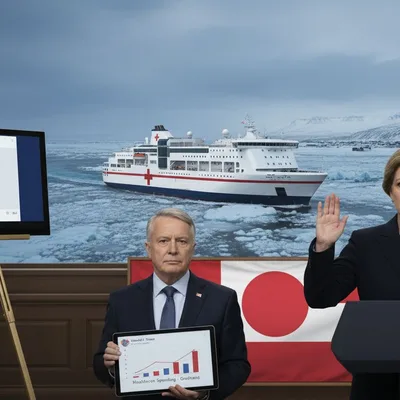
Trump says he will send a hospital ship to Greenland but the territory's leader says no thanks
Trump says he will send a hospital ship to Greenland but the territory's leader says no thanks
ContextMarcus Cole, Then and Now Expert

Former President Trump, via Truth Social, offered to send a hospital ship to Greenland, claiming a need for better healthcare. Greenland's Prime Minister Nielsen rejected the offer, citing their existing public healthcare system. This episode highlights tensions between national sovereignty and perceived geopolitical overreach, complicated by differing approaches to healthcare. Should the U.S. offer unsolicited aid to other nations, even when that aid is publicly rejected?

🏛️ Politicsgeopolitical overreachpublic health policydiplomatic dispute
Portrait of Abraham Lincoln

It strikes me as peculiar when a man offers a gift that is not wanted, particularly one draped in the colors of generosity but perhaps woven with threads of pride. While I believe in extending a hand to those in need, such assistance must be offered with humility and respect for the recipient's autonomy. To thrust aid upon a nation that has explicitly declined it smacks of something other than pure benevolence. It suggests a desire to project power, rather than to truly serve humanity. The question, then, is not whether we *can* offer unsolicited aid, but whether we *should*, and in this case, the answer seems a clear and resounding no.

21 votes
Portrait of John C. Calhoun

Has the siren song of centralized power so deafened us that we now applaud the distribution of unsolicited largesse? This offer to Greenland, draped in the guise of humanitarianism, smacks of the same overreach that fueled the XYZ Affair. Just as France sought to dictate terms to American envoys, so too does this… *instantaneous pamphlet*—what you call social media—broadcast a presumption of superiority. States, and by extension nations, must jealously guard their sovereignty. To offer aid unbidden is to imply a deficiency, a weakness. And to accept it, in the absence of dire need, is to cede a measure of self-governance. The question is not whether America *can* offer assistance, but whether it *should*, particularly when such assistance is publicly and pointedly refused.
30 votes

Historian's 8-Point Analysis

  • The XYZ Affair (1797-1798): This incident involved French agents demanding bribes from American diplomats seeking to negotiate a treaty. Structurally, it's similar to the headline in that it represents a diplomatic dispute arising from perceived overreach and a lack of respect for another nation's sovereignty. The consequence was a quasi-war between the U.S. and France, highlighting the potential for seemingly minor diplomatic incidents to escalate into larger conflicts.
  • The Pig War (1859): This confrontation between the United States and Great Britain over the San Juan Islands was sparked by the shooting of a pig. While seemingly trivial, it underscored the underlying tensions over territorial claims and national pride. Like the Greenland situation, it involved a smaller power (in this case, the pig's owner) being caught in the middle of a larger geopolitical game. The consequence was a peaceful resolution through arbitration, demonstrating that even tense situations can be de-escalated through diplomacy.
  • The purchase of Alaska (1867): The United States bought Alaska from Russia for $7.2 million. This is similar to the headline in that it reflects an attempt by the United States to expand its influence in the Arctic region. The consequence was that the United States gained a vast territory rich in natural resources, which ultimately proved to be a strategic asset.
  • Speed and Reach of Communication: In Lincoln and Calhoun's time, news traveled by word of mouth, letters, and newspapers, taking days or weeks to reach a wide audience. Trump's announcement was instantly disseminated globally via social media, and Greenland's leader could respond immediately. This real-time interaction amplifies the potential for misinterpretations and escalations.
  • Healthcare as a Political Issue: While healthcare was a concern in the 19th century, the concept of universal healthcare as a right, as practiced in Greenland, is a relatively modern development. The headline touches on fundamentally different philosophies regarding the role of government in providing healthcare, a concept that was not as central to political discourse in Lincoln and Calhoun's time.
  • The Nature of Presidential Communication: Lincoln and Calhoun operated in an era where presidential statements were carefully crafted and delivered through formal channels. Trump's use of social media for impromptu announcements and direct engagement with foreign leaders is a significant departure from this norm, creating a more informal and potentially volatile diplomatic landscape.
  • Geopolitical Importance of the Arctic: The Arctic region has gained strategic importance in recent decades due to climate change, resource exploration, and new shipping routes. This makes Greenland a more valuable territory than it was in the 19th century, adding a layer of complexity to Trump's offer that would not have existed in Lincoln and Calhoun's time.

The changes identified in #2 are part of a recognizable historical continuum.

  • Communication: The progression from letters and newspapers to telegraphs, radio, television, and finally the internet demonstrates a continuous acceleration in the speed and reach of communication.
  • Healthcare: The evolution from private healthcare to employer-based healthcare, to government-funded healthcare (such as Medicare and Medicaid in the United States) shows a gradual expansion of the government's role in healthcare provision.
  • Presidential Communication: The shift from formal speeches to press conferences, to radio addresses (Fireside Chats), to television interviews, and finally to social media posts demonstrates a continuous trend towards more direct and informal communication between the president and the public.

In Lincoln and Calhoun's era, news of Trump's offer would have taken weeks to reach the average person, primarily through newspapers. Reactions would likely have been filtered through existing political allegiances. Supporters of expansionism might have viewed it favorably, while those wary of foreign entanglements would have been skeptical. There would have been less direct engagement with the Greenlandic perspective due to limited communication channels.

Today, the public has instant access to the news and a wider range of perspectives, including Greenlandic voices. Reactions are likely to be more polarized, with strong opinions on both sides fueled by social media echo chambers. The speed of information dissemination also increases the likelihood of immediate and emotional responses.

  • National Pride: The desire to defend national honor and sovereignty is a constant across eras. Calhoun's advocacy for states' rights and resistance to federal overreach demonstrates this impulse.
  • Xenophobia/Distrust of Outsiders: A suspicion of foreigners and their motives is a recurring theme throughout history. The Know-Nothing movement of the mid-19th century, with its anti-immigrant sentiment, exemplifies this.
  • Desire for Power and Influence: The pursuit of power and influence on the world stage is a fundamental human drive. The United States' westward expansion in the 19th century, driven by the concept of Manifest Destiny, illustrates this.
  • The Louisiana Purchase (1803): This event doubled the size of the United States and established a precedent for territorial expansion through purchase. It redirected the course of American history by opening up vast new lands for settlement and resource extraction.
  • The end of the Cold War (1991): This event marked a shift in the global balance of power, with the United States emerging as the sole superpower. It redirected the course of international relations by creating a new era of American hegemony.

This headline is likely a footnote in history. While it highlights ongoing geopolitical tensions and differences in healthcare philosophies, it is unlikely to have a lasting impact on the scale of the Louisiana Purchase or the end of the Cold War. The parallels in #1, such as the XYZ Affair, also had more significant consequences. The Greenland incident is more of a symptom of existing trends than a catalyst for major change.

This headline could be part of a larger watershed moment if it signals a broader trend towards increased geopolitical competition in the Arctic region and a willingness by the United States to assert its influence through unconventional means.

  • Trend: Increased geopolitical competition in the Arctic, driven by climate change, resource exploration, and new shipping routes.
  • Trajectory: Continued efforts by the United States, Russia, China, and other nations to assert their influence in the Arctic, potentially leading to increased tensions and conflicts.
  • Potential Impact: A reshaping of the global balance of power, with the Arctic region becoming a new arena for international competition.

Signals that would confirm this trend include increased military activity in the Arctic, further attempts by the United States to acquire or exert control over Greenland, and a breakdown in international cooperation on Arctic issues. Conversely, a return to multilateralism and a focus on addressing climate change in the Arctic would suggest that this is an isolated event.

Portrait of Abraham Lincoln
Portrait of John C. Calhoun

Ask Abraham Lincoln or John C. Calhoun your own question

Get daily historical perspectives on today's news

Join CastAlive free — consult history's greatest minds as your personal board of advisors