← Back to CastAlive News

Bill and Hillary Clinton gear up for one final Washington fight
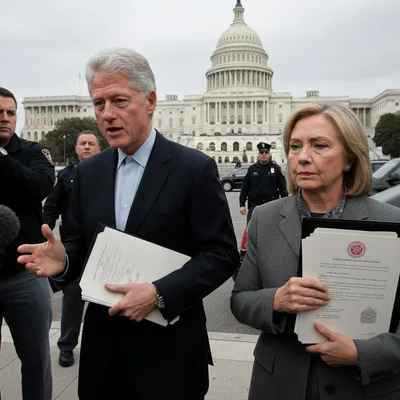
Bill and Hillary Clinton gear up for one final Washington fight
ContextMarcus Cole, Then and Now Expert

Bill and Hillary Clinton are embroiled in a congressional investigation regarding Bill's ties to Jeffrey Epstein. Subpoenaed and initially resistant, they testified this week, facing questions behind closed doors. The stakes are high: the Clintons' legacy, potential legal repercussions, and the broader implications for exposing Epstein's network. This final fight raises the question: How should society balance the pursuit of justice with the potential for politically motivated investigations that tarnish reputations?

🏛️ PoliticsCongressional testimonyEpstein investigationcontempt threat
Portrait of John Locke
John Locke1632-1704

That reputations may be tarnished by politically motivated inquiries is a truth known even before parliaments existed. The question has not changed; only the instruments with which men seek to inflict damage upon their rivals. This "congressional investigation," as it is termed, reminds one of the impeachment of Warren Hastings, though magnified by what you call a "24/7 news cycle." The pursuit of justice must always be tempered by reason and the recognition that power, whether wielded by a king or a legislative body, is ever susceptible to abuse. As I wrote in *Two Treatises of Government*, the legitimacy of any government rests upon the consent of the governed, and this consent cannot be maintained if the government becomes a tool for partisan vendettas.

25 votes
Portrait of Jean-Jacques Rousseau

Is it not always the way that those who once held power cling to it with the tenacity of ivy upon a crumbling wall? This Epstein affair, if it is as you say, echoes the case of Warren Hastings, a man besieged by accusations and political maneuverings, though lacking the swiftness of judgment your "news cycle" provides. The question of justice versus political assault is ever present. In my *Social Contract*, I argued for the general will, but even that can be manipulated by factions and self-interest. The swiftness of this "social media" – a thousand pamphlets delivered in an instant – amplifies both truth and calumny. One must remain vigilant lest the pursuit of justice be tainted by the poison of political vengeance.

24 votes

Historian's 8-Point Analysis

  • The Impeachment of Warren Hastings (1787-1795): This event shares structural similarities with the Clinton investigation. Hastings, the Governor-General of Bengal, was accused of corruption and abuse of power. Like the Clintons, Hastings faced a lengthy and politically charged investigation involving parliamentary testimony and potential legal repercussions. The consequence was a long and divisive trial that significantly impacted Hastings' reputation and British politics. The structural similarity lies in the use of a legislative body to investigate alleged misconduct of prominent figures, with potential for partisan motivations and lasting reputational damage.
  • The South Sea Bubble Scandal (1720): This event involved allegations of corruption and insider trading within the South Sea Company, a British joint-stock company. High-ranking government officials were implicated, leading to a parliamentary inquiry and public outcry. The structural similarity lies in the intersection of political power, financial dealings, and public trust. The consequence was a significant financial crisis, the downfall of several prominent figures, and increased scrutiny of government finances. This parallels the current situation where the Clintons' connections to a controversial figure and their financial dealings are under scrutiny.
  • Mass Media and 24/7 News Cycle: In Locke and Rousseau's time, news dissemination was slow and limited to printed materials and word-of-mouth. Today, the 24/7 news cycle, social media, and instant communication amplify and accelerate the spread of information (and misinformation) about the Clintons' situation. This creates a much more intense and immediate public reaction than anything they would have experienced.
  • Sophistication of Investigative Journalism: Investigative journalism has evolved significantly since the 18th century. Modern investigative techniques, data analysis, and access to information sources allow for a much deeper and more thorough examination of complex issues like the Epstein case and the Clintons' involvement. This means more details are likely to emerge, influencing public perception and the course of the investigation.
  • Political Polarization: The level of political polarization in the United States today is significantly higher than in the 18th century. This polarization influences how the investigation is perceived and interpreted, with partisan actors likely to frame the narrative to benefit their side. In Locke and Rousseau's time, while political factions existed, the intensity and pervasiveness of polarization were different.

The Then-vs-Now delta is part of a recognizable historical continuum.

  • Development of the Printing Press (15th Century): This invention marked an early step in the democratization of information, allowing for wider dissemination of ideas and news than previously possible.
  • Rise of Newspapers (17th-18th Centuries): Newspapers provided a more regular and accessible source of information for the public, contributing to the growth of public opinion and political discourse.
  • Invention of Radio and Television (20th Century): These technologies further accelerated the spread of information and created new platforms for political communication and public debate.

In Locke and Rousseau's era, an event similar to the Clinton investigation would have been primarily confined to the political elite and educated classes. Information would have spread through pamphlets, newspapers, and word-of-mouth, taking weeks or months to reach a wider audience. Public reaction would have been more measured, less immediate, and largely shaped by the opinions of influential figures.

Today, the public reaction is immediate, widespread, and often highly polarized. Social media amplifies both accurate information and misinformation, leading to a cacophony of voices and opinions. The public is bombarded with news and commentary from various sources, making it difficult to discern the truth and form a balanced opinion.

  • The Desire for Justice: The human desire for justice and accountability remains constant. In Rousseau's time, this manifested in calls for social equality and the punishment of those who abused their power. Today, this desire fuels demands for accountability in the Epstein case and for those who enabled his crimes.
  • The Tendency Towards Gossip and Scandal: The human tendency to be fascinated by gossip and scandal, especially involving powerful figures, is a constant. In Locke's time, court intrigues and rumors about the aristocracy were popular topics of conversation. Today, this tendency manifests in the intense media coverage and public interest in the Clintons' situation.
  • Partisan Loyalty: The tendency to defend one's political allies, even in the face of evidence, is a recurring feature of human behavior. In Patrick Henry's time, this was evident in the fierce debates over the ratification of the Constitution, where individuals often prioritized their loyalty to their faction over objective analysis. Today, this tendency is evident in the partisan reactions to the Clinton investigation, with supporters dismissing the allegations and opponents seizing on them to attack their political rivals.
  • Watergate Scandal (1972-1974): This event significantly altered the landscape of political accountability and investigative journalism in the United States. It led to increased scrutiny of government officials and a greater willingness to investigate alleged misconduct. The cycle of political scandal and investigation has become a recurring feature of American politics since Watergate.

The historical significance of the Clinton investigation is likely a chapter section. While it is a significant event with potential legal and political ramifications, it does not represent a fundamental shift in the structure of power or the course of history. It is part of a recurring cycle of political scandal and investigation, and its long-term impact will likely be limited. The Watergate Scandal, by comparison, was a book-defining event that fundamentally altered the relationship between the government and the public.

This headline could be part of a larger watershed moment if it contributes to a broader trend of increased scrutiny of powerful figures and their connections to controversial individuals or organizations.

  • Trend: Increasing public demand for accountability and transparency from political elites.
  • Trajectory: Continued investigations into the Epstein network and other instances of alleged misconduct by powerful figures.
  • Potential Impact: A decline in public trust in political institutions and a greater willingness to hold leaders accountable for their actions.

Signals that would confirm this being part of a larger shift:

  • Increased public support for campaign finance reform and ethics regulations.
  • A decline in political polarization and a greater willingness to work across party lines to address issues of corruption and accountability.
  • Significant legal consequences for individuals implicated in the Epstein case and other scandals.
Portrait of John Locke
Portrait of Jean-Jacques Rousseau

Ask John Locke or Jean-Jacques Rousseau your own question

Get daily historical perspectives on today's news

Join CastAlive free — consult history's greatest minds as your personal board of advisors