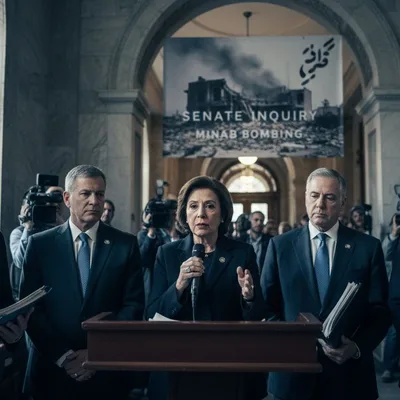
← Back to CastAlive News

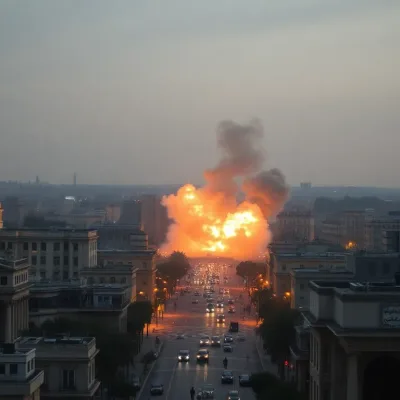
Live updates: Massive explosion strikes Iran’s capital as Israeli military says it is targeting ‘heart’ of city
Live updates: Massive explosion strikes Iran’s capital as Israeli military says it is targeting ‘heart’ of city
ContextMarcus Cole, Then and Now Expert

Breaking now: Israel claims responsibility for a massive explosion in Iran's capital, asserting a strike on the city's "heart." This follows escalating tensions, including recent joint US-Israeli attacks and the assassination of Iran's Supreme Leader. Retaliatory missile strikes have already occurred. The underlying tension is the potential for a full-scale regional war. Given these events, should a nation be allowed to attack another nation's capital?
🏛️ PoliticsMilitary strikesinternational conflictleadership assassinationIran-Israel tensions
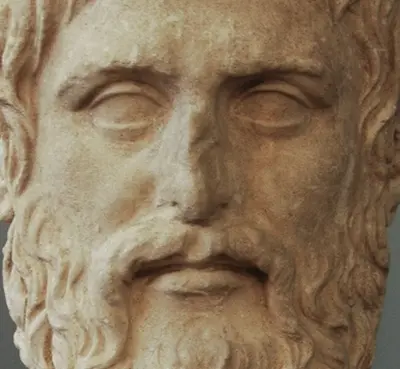
Portrait of Plato
Plato428-348 BCE

Must a physician amputate the limb to save the body? The reports speak of an explosion in the heart of a city, a calculated strike. Such actions echo Athens' assault on Syracuse, intended to cripple a potential foe, yet ushering in a period of prolonged strife. This "capital," as you term it, is the seat of power. To strike it is to invite retaliation, a cycle of violence that threatens to engulf the region. As I wrote in *The Republic*, justice demands order and proportionality. To wage war on a city is rarely just. The tools have changed, yet the motives remain familiar: fear and the pursuit of self-preservation. To answer your question directly, a nation should only attack another nation's capital if the alternative is utter destruction.

9 votes
Portrait of John Locke
John Locke1632-1704

Whether a nation *should* be allowed such an attack is a question of morality; whether it *will* be allowed is a question of power. I recall the Athenian assault on Syracuse, a preemptive strike meant to cripple a potential foe. Yet, such actions, however strategically conceived, often unravel amidst unforeseen consequences, igniting a broader conflagration. This "heart" that is targeted, it seems, is not merely brick and mortar, but the very spirit of a nation. The dissemination of news, once reliant on printed sheets slowly making their way across borders, now travels with unheard-of speed. Does this rapid spread of information lead to greater wisdom or merely amplify the passions that cloud judgment? The answer to this question will determine the fate of us all.
10 votes

Historian's 8-Point Analysis

  • The Peloponnesian War (431-404 BCE): The Athenian invasion of Sicily (415-413 BCE) bears structural similarities. Athens, a dominant power, launched a preemptive strike against Syracuse, a key ally of Sparta, based on perceived threats and strategic advantage. Like Israel's strike on Iran, the Athenian action was intended to cripple a potential enemy and secure regional dominance. The consequence was disastrous for Athens, leading to the loss of their fleet and contributing significantly to their eventual defeat in the Peloponnesian War. This parallels the potential for escalation and miscalculation in the current situation.
  • The Sicilian Vespers (1282): While not a direct military strike by one nation against another's capital, the Sicilian Vespers represents a popular uprising against foreign rule (the French Angevins) that was instigated and supported by a rival power (Aragon). This is structurally similar in that a foreign power (Aragon) fueled internal dissent and violence to weaken its enemy. The consequence was a bloody conflict and a shift in power dynamics in the Mediterranean. This relates to the current headline if one considers the potential for the Israeli strike to incite internal unrest or regime change in Iran, potentially supported by external actors.
  • The Third Punic War (149-146 BCE): The Roman destruction of Carthage is another potential parallel. Rome, fearing Carthage's resurgence, issued demands that Carthage found unacceptable, leading to war and ultimately the complete destruction of the city. While the initial trigger was different, the underlying dynamic of a dominant power seeking to eliminate a perceived threat through decisive military action is similar. The consequence was the complete annihilation of Carthage, a stark warning about the potential for escalation and total war.
  • Information Dissemination: In Plato's time, news of an event like the destruction of a major city would spread slowly, primarily through travelers and word of mouth. Locke's era saw the rise of printed newspapers, but information still took days or weeks to travel across continents. Today, news of the explosion in Iran's capital is instantly available globally via the internet and 24-hour news channels. This immediacy amplifies the emotional impact and pressure on leaders to respond.
  • Weapons Technology: Plato's world had bronze weapons, siege engines, and triremes. Locke's era saw the development of gunpowder weaponry, including cannons and muskets. Today, we have precision-guided missiles, stealth aircraft, and potentially nuclear weapons. The destructive potential of modern weaponry is exponentially greater, making the stakes of conflict significantly higher.
  • International Organizations and Law: Neither Plato nor Locke lived in a world with established international organizations like the UN or codified international law. Today, the UN Security Council is expected to address the situation in Iran, and international law governs (at least nominally) the conduct of warfare. This creates a framework for diplomatic intervention and potential sanctions, which did not exist in earlier eras.
  • Global Interdependence: In Plato's time, trade and political connections were largely regional. By Locke's era, global trade networks were developing, but the world was still less interconnected than it is today. The modern global economy means that a conflict in the Middle East can have immediate and significant repercussions for economies around the world, influencing oil prices, trade routes, and financial markets.

The changes in information dissemination form a recognizable continuum. The progression is:

1. Oral Tradition (Plato): News spread by word of mouth, making it slow and prone to distortion. 2. Early Print (Locke): Newspapers allowed for wider and more accurate dissemination of information, but still with delays. 3. Telegraph and Radio (19th/20th Century): Instantaneous communication over long distances became possible, accelerating the spread of news. 4. Internet and Social Media (Today): Information is instantly available globally, with the added dimension of user-generated content and rapid dissemination of opinions.

In Plato's time, the average Athenian citizen would likely have learned about an event like this days or weeks later, depending on the location. Their reaction would be shaped by the messenger's account and their existing biases. Public opinion would be influenced by orators and political leaders. In Locke's era, news would spread through newspapers and pamphlets, allowing for a wider dissemination of information but still with significant delays. Public reaction would be shaped by the political leanings of the newspapers and the opinions of influential figures. Today, the public would be immediately bombarded with information from various sources, including news outlets, social media, and government statements. Reactions would likely be polarized, with strong opinions expressed on both sides of the issue. There would be a greater emphasis on immediate action and accountability.

  • Fear and Self-Preservation: The instinct to protect oneself and one's community remains constant. In Plato's time, the fear of invasion and enslavement motivated Athenian citizens to fight in wars. Today, the fear of terrorism and nuclear war drives public opinion on national security issues.
  • Desire for Justice/Revenge: The impulse to seek justice or revenge for perceived wrongs is a recurring theme in human history. In Locke's era, the concept of natural rights and the social contract fueled revolutions against oppressive regimes. Today, this impulse manifests in calls for retaliation against those responsible for the explosion in Iran.
  • Group Identity and Loyalty: The tendency to identify with a group and feel loyalty towards it is a fundamental aspect of human nature. In both Plato and Locke's time, people identified strongly with their city-state or nation and were willing to fight and die for it. Today, this manifests in nationalism, patriotism, and support for one's country's foreign policy.
  • The Treaty of Westphalia (1648): This treaty established the modern state system, based on the principles of sovereignty and non-interference. It marked a shift away from religious wars and towards a system of international relations based on diplomacy and power politics. The current conflict challenges this system, as the Israeli strike on Iran could be seen as a violation of Iranian sovereignty.
  • The Iranian Revolution (1979): This event transformed Iran into an Islamic republic and ushered in a period of increased tension between Iran and the West, particularly the United States and Israel. The revolution marked a turning point in the region and has shaped the geopolitical landscape for decades. The current conflict is a direct consequence of the ongoing tensions stemming from the revolution.

The headline's likely historical importance is chapter-defining. While there have been numerous conflicts in the Middle East, the combination of a direct military strike on Iran's capital, the assassination of its Supreme Leader, and the potential for wider regional conflict significantly elevates the stakes. This event could mark a major escalation in the Iran-Israel conflict and potentially lead to a wider war, reshaping the geopolitical landscape of the Middle East and beyond. This event is likely more significant than the Sicilian Vespers, but less impactful than the Treaty of Westphalia.

Yes, this headline could be part of a larger watershed moment. The trend is towards increasing instability in the Middle East, driven by factors such as the rise of non-state actors, the proliferation of weapons, and the ongoing tensions between Iran and its rivals. The trajectory is towards a potential regional war, with devastating consequences for the region and the world.

Signals that would confirm this being part of a larger shift include:

  • Further escalation of the conflict, such as Iranian retaliation against Israel or US targets.
  • Involvement of other regional powers, such as Saudi Arabia or Turkey.
  • Collapse of the Iran nuclear deal and a renewed push by Iran to develop nuclear weapons.
  • Significant disruption to global oil supplies.
Portrait of Plato
Portrait of John Locke

Ask Plato or John Locke your own question

Get daily historical perspectives on today's news

Join CastAlive free — consult history's greatest minds as your personal board of advisors